

Echeveria pulidonis

Updated: Aug 22, 2023
Echeveria, also known as rockroses in South Africa and generally as Hens and Chickens for the proliferating habit of some varieties.
It is a large and variable genus of leaf succulents in the Crassulaceae family and are mostly known from central America, specifically Mexico.
With all the variable leaf shapes and colours found in the species and forms, this genus leans itself to hybridizing and thw developing new cultivars. It's compatibility in intergeric hybrids with the other related genera further allows the development of beautiful new plants.
Echeveria pulidonis E.Walther, Echeveria 122, fig. 60 (1972)

Known as the Pulido's Echeveria, E. pulidonis is a very popular and easy growing succulent plant. This species was described in 1972 and was named in honor of Señor Miguel Pulido of Mexico City.
It is known from Mexico and is rather limited in distribution.
The plants form stemless rosettes, solitary at first and producing offsets as they grow older. The leaves are oblong, grey to green with a red to reddish-brown margin on the tip.
The plants produce multiple inflorescenses with flowers nodding down during development.

There are at least two beautiful variegated forms that are known, the nice yellow variegated form and a white-grey form which appears to be a monstrose vatiegation.
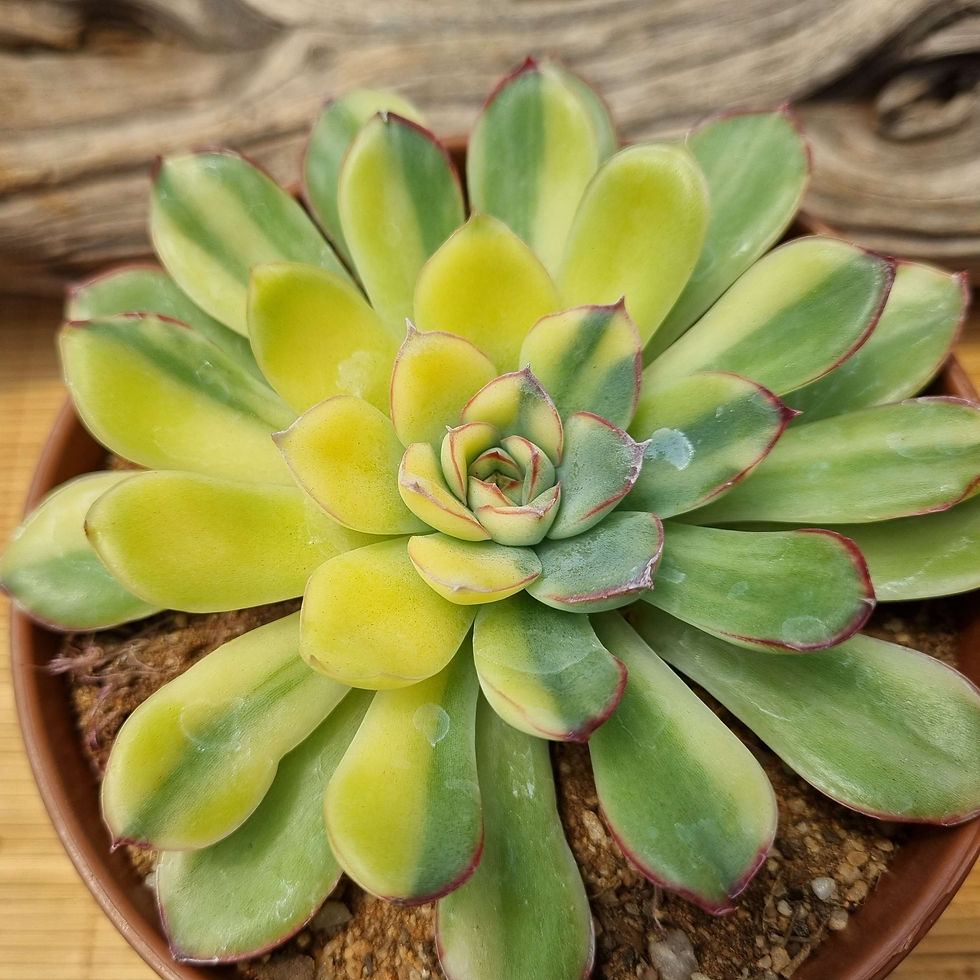
This plant does very well in containes, either on its own or complimented by a mixed succulent planting in bowls. In most areas it will also do very well in the garden planted in the rockery or used as a border plant.
The greener leaved, red edged form is sometimes reported as a hybrid of E. pulidonis, however this one often self-seeds itself here in the nursery and the seedlings are very uniform with slight variation of the green tone and red edge, implying that it is the pure species or form thereof.

Comments